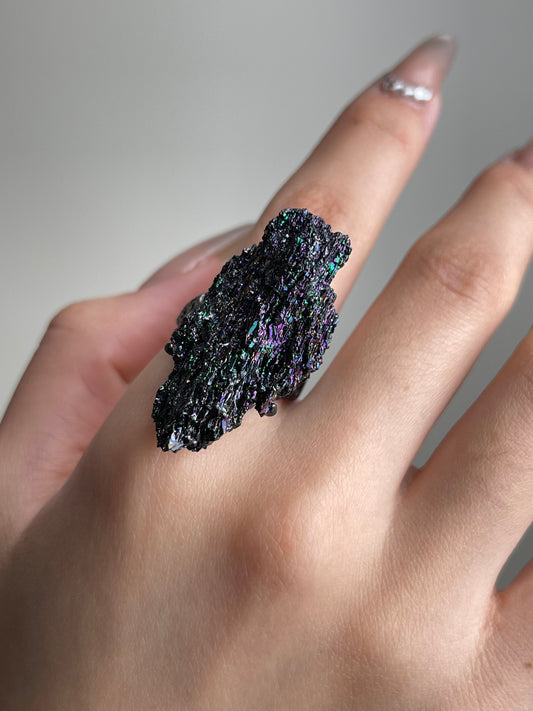
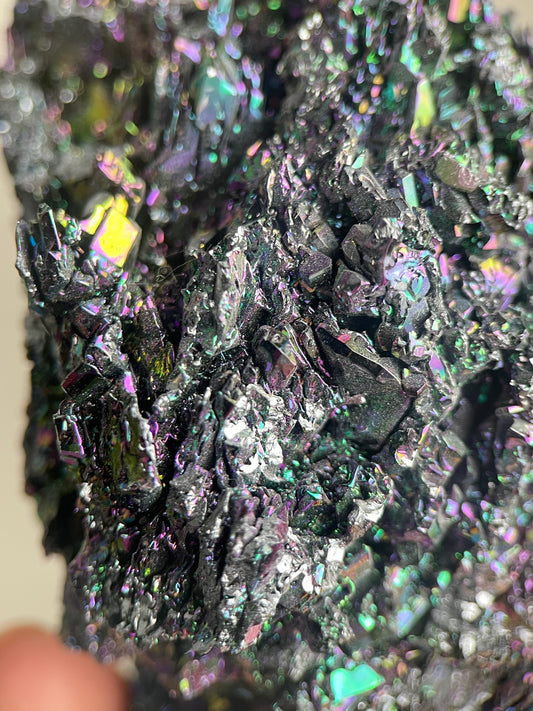
Collection: Carborundum (Silicon Carbide)
A synthetic material composed of silicon and carbon,
first produced in the late 19th century
during experiments to create artificial diamonds.
Carborundum forms under extremely high temperatures,
where silicon and carbon combine
to create a hard, crystalline structure.
Unlike natural minerals,
its formation is controlled rather than geological —
resulting in sharp edges, metallic luster,
and often iridescent surfaces.
It became widely used in industry
as an abrasive material,
valued for its durability and resistance to wear.
Today, it is also appreciated for its appearance —
dark, reflective,
with flashes of color across the surface
as light moves over it.